
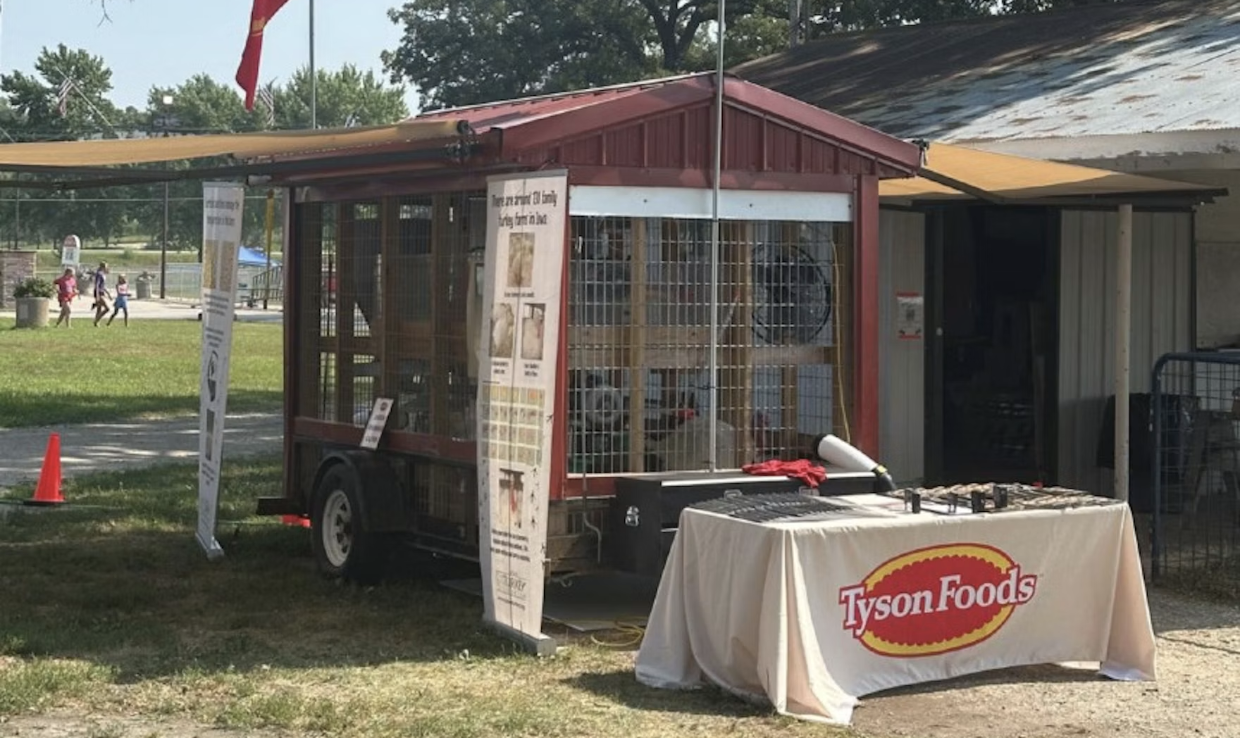
Outreach program talks turkey to give the community an in person lesson about poultry production and processing.
A mobile turkey barn run by Tyson Foods provides children in Iowa a hands-on look at how turkeys are raised, helping kids learn more about how food is produced. The self-contained trailer is designed to match a working turkey farm, with the same kind of equipment and litter. It includes a working feed line that the turkeys trigger themselves and an environmental controller.
“Terms like ventilation, automatic feeding, environmental control can sound complicated in a presentation, but seeing the equipment, it helps them get a great idea of what goes on in the barn,” Allen Bond, animal welfare specialist at Tyson Foods, explained October 22 during a virtual member mixer put on by the International Poultry Welfare Alliance.
The educational initiative is a collaboration between the Tyson Foods turkey facility in Storm Lake, Iowa, the Iowa Turkey Federation and the Iowa Turkey Marketing Council. It grew from a school program for children in Sac County, Iowa, and from a retired Iowa Turkey Federation barn that moved to the Clay County Fair in partnership with Tyson. At the Clay County Fair earlier this year, about 750 children visited the exhibit, and about 250 more attended the following week in Newell, Iowa. The exhibit has also appeared at a community Kids Fest in Storm Lake and a high school job fair.
The goal is to be someone they trust
Bond said staff aim for conversations rather than debates, and children tell them directly what they want to know. One of his main lessons is to explain a practice before demonstrating it. When staff said they were about to show the approved way to pick up a turkey, he said, visitors accepted it without hesitation.
“Tell them what you’re doing before you do it, and they’re less skeptical than when you just do it,” Bond said. Children have also asked tough questions. Bond said one student asked on his first outing whether the birds would be murdered when the company was done with them.
“You can’t let questions like that go unanswered,” he said. Other common questions concern beak conditioning, which Bond explains is done humanely at the hatchery, and the “factory farm” label. For the latter, he points to banners and fact sheets showing farm families in turkey barns. “A lot of the kids are y’all’s age. They help on the farms,” Bond said.
“These are not factory farms. They’re run by family farmers.” His approach, he said, is to talk with children the way he would with his grandchildren. “The whole idea is people trust Grandpa, and the whole idea is to be somebody that they trust,” Bond said.